| Number of credits available | Minimum standards |
|---|---|
| 4 | No |
To reduce the level of greenhouse gas emissions arising from the leakage of refrigerants used to heat or cool the building.
This issue is split into two parts:
The following is required to demonstrate compliance:
| 1 | Where the building does not require the use of refrigerants within its installed plant or systems, or any off-site system it is connected to. |
OR alternatively, where the building does require the use of refrigerants, all the available credits can be awarded as follows:
| 2 | All systems (with electric compressors) must comply with the requirements of EN 378:2008+A2:20121EN 378 Refrigerating systems and heat pumps – Safety and environmental requirements, 2008+A2:2012 (parts 2 and 3) or ISO 5149:20142I SO 5149 Refrigerating systems and heat pumps – Safety and environmental requirements, 2014 and where refrigeration systems containing ammonia are installed, the Institute of Refrigeration Ammonia Refrigeration Systems Code of Practice3Ammonia Refrigeration Systems Code of Practice, Institute of Refrigeration, 2009 |
| 3 | The refrigerants used must have an ozone depleting potential of zero. |
| 4 | Where the systems using refrigerants have Direct Effect Life Cycle CO₂ equivalent emissions (DELC CO₂ₑ) of ≤ 100 kg CO₂ₑ/kW cooling or heating capacity. To calculate the DELC CO₂ₑ., please refer to Relevant definitions and Methodology. OR |
| 5 | Where air-conditioning or refrigeration systems are used to heat or cool the building the refrigerants used have a Global Warming Potential (GWP) ≤ 10. |
OR
| 6 | Where the systems using refrigerants have Direct Effect Life Cycle CO₂ equivalent emissions (DELC CO₂ₑ) of ≤ 1000 kg CO₂ₑ/kW cooling or heating capacity. |
| 8 | The system must be capable of automatically isolating and containing the remaining refrigerant charge in response to a leak detection incident (see Other information). |
None.
| Ref | Terms | Description |
|---|---|---|
| Shell and core (non-residential and residential institutions only) | ||
CN1 | Applicable assessment criteria | Shell only: This issue is not applicable. Shell and core: All criteria relevant to the building type and function apply.Refer to Appendix D – Shell and core project assessments for a more detailed description of the shell and core assessment options. |
CN1.1 | Avoiding the need for refrigerants | Shell and core: If the building is designed in such a way that it avoids the need for refrigerant containing building services or connection to off-site systems, and therefore no 'refrigerant-using' building services or systems will be specified for the fit-out, then the available credits can be awarded by default. |
| Residential - Partially fitted & Fully fitted | ||
CN2 | Applicable Assessment criteria - Single and multiple dwellings | Both options: All criteria relevant to the building type and function apply. Refer to Appendix E – Applicability of BREEAM New Construction to single and multiple dwellings, partially and fully fitted for a more detailed description of residential assessment options. |
| General | ||
CN3 | Industrial buildings without offices & with untreated operational areas | This issue will be filtered from the scope of assessment for industrial units designed without offices and where the operational area will be untreated, i.e. not designed to be air-conditioned or contain a cold storage facility with refrigeration plant. |
CN3.1 | Country regulations on the use of Ozone Depleting Substances (ODS) | Where legislation within the country of assessment prohibits the use of ozone depleting substances in new refrigeration systems, the credit for using substances with an ozone depletion potential of zero will be filtered out of the assessment. At the time of writing all European countries are known to fall into this category. |
| Refrigerant charge of less than 6kg | For installations of small multiple hermetic systems only where the refrigerant charge in each unit is less than 6kg, the credit for leak detection and containment can be awarded by default. This is on the basis that the risk of a large refrigerant leak due to system failure is minimised, as individual leaks from each system will be small where leakage occurs, and therefore there is little life cycle benefit of requiring leak detection equipment on each small system. Note: solutions such as this may be less energy efficient and as such may impact on the achievement of credits under . | |
CN3.3 | Specification of multiple systems | Where more than one air-conditioning or refrigeration system is servicing the building, the assessor must source the relevant technical data for each system and enter it into the Pol 01 calculator. The calculator will then determine the weighted average DELC for the multiple installation and the BREEAM credits can be awarded or withheld accordingly. |
CN3.4 | Leak detection. | The refrigerant leak detection criteria are still applicable in instances where any type of non-solid refrigerant is present, i.e. even if the refrigerant meets BREEAM's DELC CO₂ₑ benchmarks. Exceptions to this are systems that use natural and environmentally benign refrigerants, such as air and water (for example lithium bromide or water absorption chillers) and installations of small multiple hermetic systems, where CN3.2 applies. These types of system and refrigerants will achieve the leak detection credit by default. |
CN3.5 | ODPOzone Depleting Potential data not available | Where ODP data for the specified refrigerant are not available, the credit cannot be awarded on a default basis. |
The number of Pol 01 BREEAM credits achieved is determined by the assessor using the BREEAM Pol 01 calculator.
The Direct Effect Life Cycle CO₂ₑ emissions (DELC) per kW of cooling and heating capacity are calculated using the following equation:
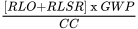
Where:
Refrigerant loss operational (RLO) = (Refcharge x Sys op-life x (L1 + L2 + S1 + S2))/100
Refrigerant loss system retirement (RLSR) = Refcharge x (1 - RefRecEff/100)
Where:
The following default values must be used, where system specific data are not available:
Sysop-life: System operational design life (years): see Table 54
RefRecEff: Refrigerant recovery efficiency factor (%): 95%
L1: Annual leakage rates (% refrigerant charge): see Table 55
L2: Annual purge release factor (% refrigerant charge): 0.5 (if the system does not require an annual purge, zero should be used)
S1: Annual service release (% refrigerant charge): 0.25 (this applies where the system requires opening up to carry out the annual service. For systems which do not require opening up, there will be no associated annual release of refrigerant, therefore a default of zero should be used)
S2: Probability factor for catastrophic failure (% refrigerant charge loss/year): 1% (based on a failure rate of 1 in 100 systems).
The following information must be sourced from the design team's mechanical and electrical engineer or system manufacturer:
Table 54 Default system operational design life values
| System type | Default system operational design life values (years) |
|---|---|
| Small and medium capacity chillers | 15 |
| Large capacity chillers | 20 |
| Unitary split | 15 |
| Variable Refrigerant Flow (VRF) system | 15 |
| All other systems | 10 |
These figures are based on those reported in LOT 6 for air-conditioning units and the British Refrigeration Association's (BRA) Guideline Methods of Calculating TEWI (2006)4Guideline Methods of Calculating TEWI Issue 2, (2006), BRA Specification.. Note: The following should be considered when determining whether the system specified is defined as small or medium or large:
| |
Table 55Average annual leakage rates
| System type | Annual leakage rate (% of charge per annum) |
|---|---|
| Cold storage and display systems | |
| Integral cabinets | 3% |
| Split or condensing units | 18% |
| Centralised | 19% |
| Air-conditioning systems | |
| Unitary split | 15% |
| Small-scale chillers | 10% |
| Medium or large chillers | 5% |
| Heat pumps | 6% |
| These figures are based on those reported in LOT 6 for air-conditioning units and also Table 2 of the Market Transformation Programmes Briefing Note for Commercial Refrigeration no. 36, 'Direct Emission of Refrigerant Gases' (version 1.2). The figures are based on the average of the leakage rates from the four separate studies reported in Table 2 (where a range is reported, the higher value was used). | |
| Criteria | Interim design stage | Final post-construction stage |
|---|---|---|
| All | The following as appropriate:
| As design stage. Assessor’s building or site inspection or as-built drawings. Manufacturer’s information. |
Any system that isolates and contains refrigerant within the system so as to minimise leakage to the atmosphere in the event of a systems failure. An example of a system which could meet criterion 8 would be one which initiates an automated shut down and pump down of the refrigerant into a separate storage tank.
Table 56List of some common refrigerant types with low GWP
| R-Number | Chemical name | GWP 100-year |
|---|---|---|
| R-30 | Dichloromethane | 9 |
| R-170 | Ethane | 3 |
| R-290 | Propane | 3 |
| R-600 | Butane | 3 |
| R-600a | Isobutane | 3 |
| R-702 | Hydrogen | 5.8 |
| R-717 | Ammonia | 0 |
| R-718 | Water | |
| R-729 | Air (nitrogen, oxygen, argon) | |
| R-744 | Carbon dioxide | 1 |
| R1150 | Ethylene | 3 |
| R-1234yf | 2,3,3,3-Tetrafluoropropene | |
| R-1270 | Propylene | 3 |
Sources: The United Nations Environment Programme (UNEP) '2010 Report of the Refrigeration, Air-conditioning and Heat Pumps Technical Options Committee' (pages 29-30). EN 378-1:2008+A2:2012: Refrigerating systems and heat pumps - Safety and environmental requirements. Part 1: Basic requirements, definitions, classification and selection criteria - Annex E. The Intergovernmental Panel on Climate Change 5th Assessment Report, Chapter 8, 'Anthropogenic and Natural Radiative Forcing', 2013. 'Global environmental impacts of the hydrogen economy', Derwent et al, 2006. | ||
The formula used to calculate the Direct Effect Life Cycle CO₂ₑ emissions in BREEAM is based on the Total Equivalent Warming Impact (TEWI) calculation method for new stationary refrigeration and air-conditioning systems. TEWI is a measure of the global warming impact of equipment that takes into account both direct emissions (as assessed in this BREEAM issue) and indirect emissions produced through the energy consumed in operating the equipment (which is assessed in the BREEAM energy section).
Refer to EN 378-16EN 378-1 Refrigerating systems and heat pumps - Safety and environmental requirements Part 1: Basic requirements, definitions, classification and selection criteria. 2008 + A2:2012 and the British Refrigeration Association's (BRA) Guideline Methods of Calculating TEWI for further details. The BRA publication also includes sectorial release factors for new systems designed to best practice standards.
REAL Zero was a UK led project to investigate the causes of and solutions to refrigerant leakage, against the background of the EUEurope F Gas Regulation. It brought together expertise across sectors and provided practical guides and training booklets. It was subsequently updated and developed into a European e-learning programme known as REAL Skills.
For further information including guidance notes, calculators, tools and case study information visit: http://www.realskillseurope.eu/
Both CFCs and HCFCs are now tightly controlled or due to be phased out in the foreseeable future in all signatory countries to the Montreal Protocol on Substances That Deplete the Ozone Layer, BREEAM only recognises refrigerants that have an ODP of zero. Table 57 gives current ODP figures for a range of available substances that are capable of acting as refrigerants; assessors should use this to verify the ODP of the specified refrigerant. Substances not on this list should be referred to the BREEAM office so that an appropriate figure can be established.
Note: This table omits substances that are not typically used as refrigerants in buildings.
Table 57Ozone depleting potential of refrigerants
| Refrigerant type | Ozone depleting potential |
|---|---|
| R11 (CFC-11) | 1.00 |
| R12 (CFC-12) | 1.00 |
| R113 (CFC-113) | 0.80 |
| R114 (CFC-114) | 1.00 |
| R115 (CFC-115) | 0.60 |
| R125 (CFC-125) | 0.00 |
| Halon-1211 | 7.90 |
| Halon-1301 | 15.90 |
| Halon-2402 | 6.00 |
| Ammonia | 0.00 |
| R22 (HCFC-22) | 0.05 |
| R123 (HCFC-123) | 0.02 |
| R134a (HFC-134a) | 0.00 |
| R124 (HCFC-124) | 0.02 |
| R141b (HCFC-141b) | 0.11 |
| R142b (HCFC-142b) | 0.07 |
| R143a (HFC-143a) | 0.00 |
| R32 (HCFC-32) | 0.00 |
| R407C (HFC-407) | 0.00 |
| R152a (HFC-152a) | 0.00 |
| R404A (HFC blend) | 0.00 |
| R410A (HFC blend) | 0.00 |
| R413A (HFC blend) | 0.00 |
| R417A (HFC blend) | 0.00 |
| R500 (CFC/HFC) | 0.74 |
| R502 (HCFC/CFC) | 0.33 |
| R507A (HFC azeotrope) | 0.00 |
| R290 (HC290 propane) | 0.00 |
| R600 (HC600 butane) | 0.00 |
| R600a (HC600a isobutane) | 0.00 |
| R290/R170 (HC290/HC170) | 0.00 |
| R1270 (HC1270 propene) | 0.00 |
The United Nations Environment Programme (UNEP) '2010 Report of the Refrigeration, Air-conditioning and Heat Pumps Technical Options Committee' (pages 29-30). EN 378-1:2008+A2:2012: Refrigerating systems and heat pumps - Safety and environmental requirements. Part 1: Basic requirements, definitions, classification and selection criteria - Annex E. | |
BREEAM International New Construction 2016
Reference: SD233 – Issue: 2.0
Date: 03/07/2017
Copyright © 2017 BRE Global. All rights reserved.